-
External:
· Elongated fusiform and robust body covered with
small cicloid scales.
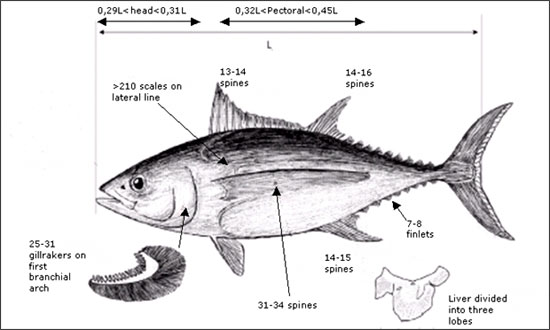
· Long pectoral fins (up to 30% of fork length or
longer in fishes longer than 50 cm), reaching second dorsal
finlets (or beyond second dorsal fin). However, they are
relatively short in individuals shorter than 30 cm. Often
confused with juvenile T. obesus which also has long pectoral
fins but with rounded tips.
· Lack of stripes or spots distinguishes the albacore
from other tuna.
· Caudal peduncle slender, keel on each side.
· Caudal fin relatively short, wide and strongly
crescent-shaped, with a narrow white posterior margin, which
is unique to this species.
· Greatest body depth at or slightly before level
of second dorsal fin, deepest at a more posterior point
than in other tunas. Second dorsal fin clearly lower than
first dorsal fin.
· The back dorsal fin and anal fin are both soft
rayed. Ventral fins are small.
· Dorsal spines (total): 11-14, dorsal soft rays
(total): 12-16, anal spines: 0-0; anal soft rays: 11-16
· Vertebrae: 18 precaudal plus 21 caudal.
· Total gillrakers on first arch: 25-31. They are
lancet-like.
.
|
|
| |
- Colour:
· Metallic dark blue on the dorsal side and silvery white on the ventral side; a faint lateral iridescent blue band runs along sides in live fish.
· First dorsal fin deep yellow, second dorsal and anal fins light yellow, anal finlets dark. Posterior margin of caudal fin white.
- Internal:
· Liver striated on ventral surface (vascular network); divided into three lobes and central lobe is largest.
· Swimming bladder present but poorly developed, not evident in fish smaller than 50 cm fork length.
|
-
External characteristics of albacore larvae:
· Yolk-sac larvae are around 2,5 mm fork length.
· Unlike other tuna, albacore larvae are characterized
by the lack of pigment in the caudal area (Nishikawa and Rimmer
1987).
· The head is big, representing 47% of standard length
(Dicenta 1975) and pigmented on the central part.
· Teeth are sharply curved in the distal part.
|